
I think it's safe to say that anyone reading this blog will know a thing or two about gaming - video or tabletop. Probably, you'll also have heard of gamification - like when your corporate overlords make you compete for your all or nothing bonuses instead of just paying everyone a fair split of the wage†. Possibly, you'll have encountered the idea of UX somewhere outside of the context of this blog - though if you haven't, I don't blame you, it's real hard to find concise resources on this topic that aren't rambling messes of a blog like this one.
But have you ever thought about how UX and Games overlap outside of gamification as a way to get people to spend money they shouldn't and do things they have no desire to do? No? Just me?
Alright, see you next time!
Naw, just kidding. I'll let you in on the secret. See, the thing is, the core concept of Game Design is really the same as the core concept of User Experience. Both disciplines pose the following fundamental questions:
- How do we get the {user/player} to interact with our {software/game/product} in the way that we want them to?
- How do we get the {user/player} to enjoy their time experiencing what we've built as much as possible?
Sure, some games might ignore the second question - I'm looking at you, THE LONGING. And some games and experiences, you could argue, don't want to predicate a way for the {user/player} to interact with them, but rather choose their own approach to using them. I'd argue, to the second, that that philosophy is the desired interaction, but at this point that makes me feel like I'm regressing to the dark days of studying philosophy. Get it, regressing? No? Good. In any case, we're just going to put aside the latter question.
In broad strokes, though, that's the core of it, and were it not for needing to justify this claim with further reasoning and examples, we could end this article here. UX and Game Design are the same thing - the only difference is the kind of experience you're designing.
I think it's important to note, at this point, that it might seem that game design is a subdomain of UX design. It's not - it's more akin to both Spanish and Italian coming from the same root language, but we all know what happens when we tell a {Spaniard/Italian} that they're the same language. More importantly, both UX and Game Design can act as a subset of the other in the right context.

For example, when designing a game, you need to answer core UX questions like "how do I make my complex concepts understandable for the player," "what kind of onboarding flows do I need to introduce my player to my experience in a way that they want to continue it," or even "how do I design my UI elements to be easily and cleanly readable while still allowing UI design space to evoke the theme of the game."
On the flip-side, when designing non-game software, you have game design questions often pop up like "how do I get my user to want to log on every day to keep their stre-"
Hold on, that's gamification, let's try again: questions like, "how do I get my users to want to use my app more than their friends, like via a leaderb-"
Shit. Failed again. Last try? Questions like, "how do I get my user to complete their profile with a percent-based sco-"
Okay, fine, it's mostly just gamification. But to be fair, gamification isn't always corporate hellhole manipulation. Sometimes it's used for good, and can make us adopt behaviours that we otherwise wouldn't want to. And of course everyone knows the psychotic self-immolating owl that guilts us into learning languages. Just because the most common cases for it tend to be less-than-in-our-interests, doesn't mean the design pattern is evil intrinsically.

At the end of the day, it boils down to this: both UX patterns and games attempt to form some kind of desired feelings and behaviour by funneling a user through a set of "guide rails". Where it gets really interesting is when we start looking at just how certain game design patterns are pretty much indistinguishable from classic modern UX patterns.
For example, everyone here's encountered an urgency pattern in the wild. Let's say you're doing your usual definitely-necessary-I-have-7-rationalizations online shopping spree, and you add an item to your cart. "Sweet, there's piles in stock," you think, seeing the 999+ on the item's page. Then, suddenly, you see a timer pop up on the cart and a message that that item's only reserved for another 15 minutes!
There's no reason for you to worry - there's 999+ of that item in stock, there's no chance that it'll sell out. But lizard brain still suddenly makes you shop faster, worried about missing the timeout.
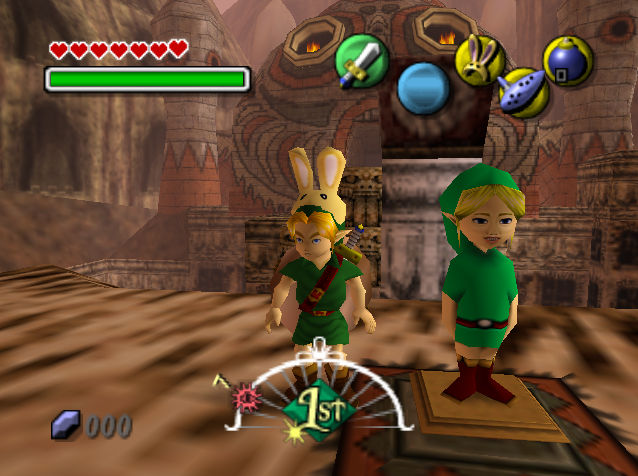
The timer on that cart? It's the same thing as the timer at the bottom of your screen in Zelda: Majora's Mask. There's no stakes to the Moon falling down - you're just going to wake up at the beginning of the cycle and get to go again. But it's constantly there, right in the middle of the screen, and it makes you feel what Link must feel in the moment: this dreadful fear of repeated, inevitable death.
Hell, there's even a timer-extension button in the game in the form of the Inverted Song of Time. Take that, Temu. Shigeru Miyamoto did it first.
That's a bit of a complex, specific pattern, though. Let's look at something simple like a Call-to-Action button. CTAs work on the principle that they're the first thing people see, both by placement and by visual contrast. I mean, how often have you been half-asleep, doom-scrolling, and accidentally clicked not on the button you wanted to, but the button that was shiny, big and in the middle of your screen?
How about the opposite question: how many games of Oblivion have you started without going to the Elven Ruins by the Lake right after coming out of the sewers? How about Skyrim games where you didn't go into Bleak Falls Barrow followed by the Embershard Mines right after Alduin's Great Helgen Cookout?

I'd wager very few, because in both cases the button and locations:
- Stand out, either on the UI, visually on the horizon, or on the compass,
- Are more frictionless than the alternatives, being bigger and closer, and
- As a result are the first thing you notice and drift towards.
There's a lot more examples out there, both of cases where this works and of cases where it really doesn't. For the former, play Solium Infernum or Dune and see how you interact with your soon-to-be-ex-friends, or take a wander into Fallout: New Vegas and try to go straight to where Mr. Suit is via the mountains to the north-east, and then see if you end up taking the long way round like God the Game Designers intended you to.
For the latter, let's head on back to Skyrim or Oblivion - much like Descartes' God, a Perfect Game must be Perfect in Every Way, and thus must also be Perfectly Bad At UX at the same time - and tell me your build didn't devolve into being a stealth archer and stealing everything from every shop by using a little-known thieves' tool - the humble pot.

There's also a discussion to be had about UX Dark Patterns, like we see in Gacha Games and Games That Pretend Not To Be Gacha Games - but that's a discussion for another time.
Anyway, I hope I've made my point in a somewhat concise way - personally, I believe that being a gamer (I really wish there was a better word, trust me) makes me a better UX designer, and learning more about UX design makes me both a better game designer and more attentive when playing games. Now go into the world, ye all, and have your experiences ruined because of the veil I pulled back on how you're all being manipulated, both when playing games and just when you use your favourite apps.
Oh, and, come back here and drop some comments. I'm dying to know what other examples you all find.
'Til next time!
† Not that this is a new idea - as with many corporate hellscape flavoured abuses of psychology, the communists did it first. But that's - you guessed it - another article for another time.